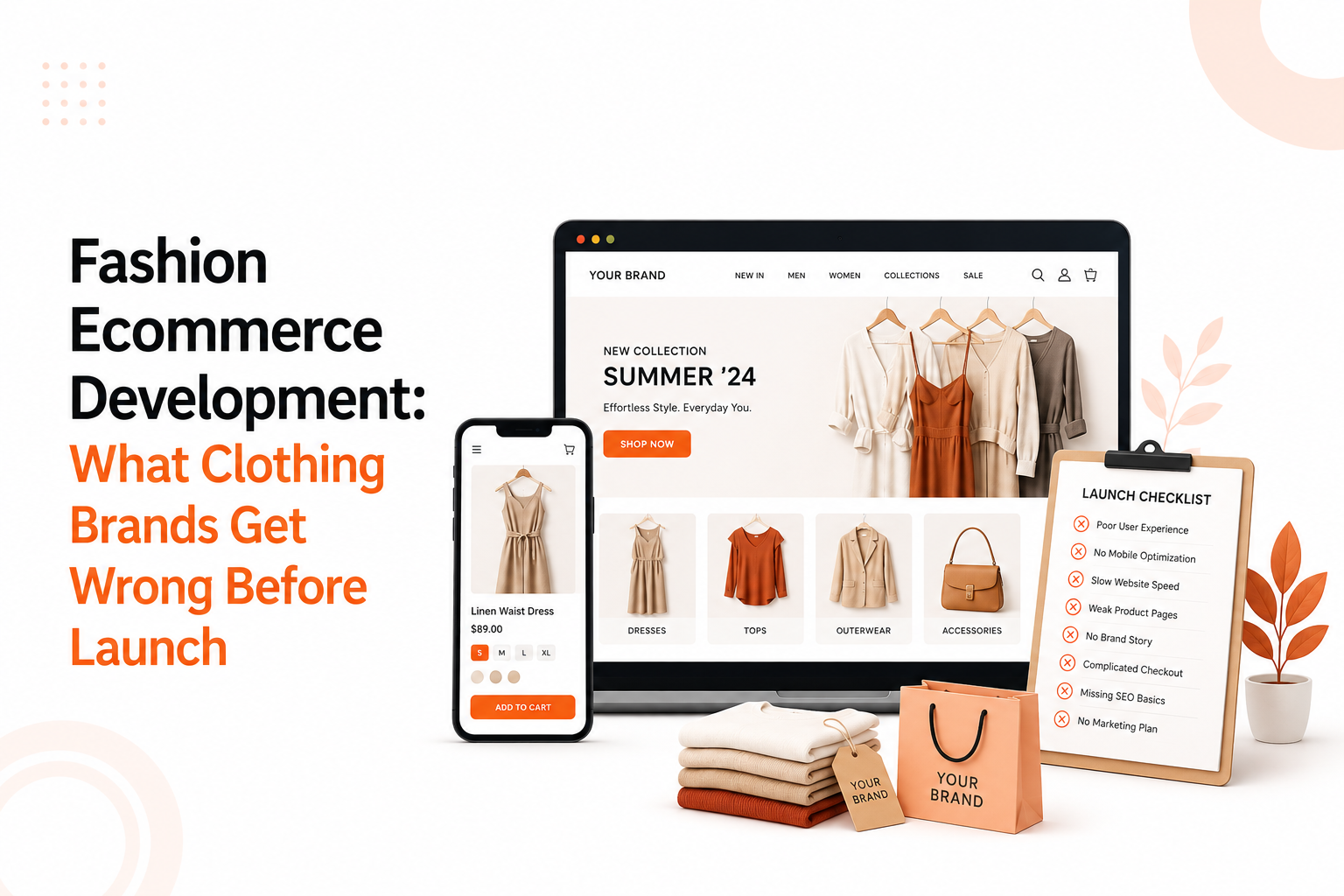
Fashion Ecommerce Development: What Clothing Brands Get Wrong Before Launch
A founder we spoke with had done everything “right.” Great product photos, a clean Shopify theme, a launch date circled on the calendar. Three months in, sales were decent – and so was the panic, because almost 1 in 3 orders was coming back. Wrong size. Colour looked different in person. “Didn’t fit as I expected.” The margin she’d planned around was gone before it ever hit her bank account.
Nothing about her launch was careless. The mistake had already been made weeks earlier, sitting in decisions nobody flags as “launch decisions” – the size chart she copy-pasted from a supplier, the product photos shot on one model in one size, the return policy she wrote in an afternoon because a lawyer friend said she needed one.
If you’re planning a fashion ecommerce store right now, this is the guide for that exact moment – before the inventory is ordered, before the platform is picked, before the launch date is locked. Fashion ecommerce is one of the few product categories where the biggest problems aren’t discovered after launch. They’re built into the ecommerce store development process before it even goes live, and they’re expensive to unwind once real orders start coming in.
Quick Answer
Most fashion ecommerce store failures trace back to decisions made before launch, not after. The biggest ones: a size chart that doesn’t actually prevent wrong-size orders, product photography shot on a single body type, a returns policy written without modelling the real cost of a 20–40% apparel return rate, and a platform chosen for its launch-week price instead of its ability to scale. Fixing these before your fashion ecommerce store goes live is far cheaper than correcting them after your first hundred orders come in.
Why Fashion Ecommerce Punishes Small Mistakes Harder Than Other Categories?
Clothing has a return problem no other major ecommerce category deals with at the same scale. Apparel return rates commonly sit between 20% and 40%, well above electronics (roughly 8–15%) or beauty (roughly 4–12%), and some fashion subcategories – women’s wear especially – run even higher. The reason is structural, not a sign you’re doing something wrong: clothing is one of the only things people buy online that has to fit one specific body, and a photo can’t confirm that the way it can confirm a phone case will fit a phone.
Fit and sizing issues alone account for roughly 45–53% of all apparel returns industry-wide – by far the single biggest driver, ahead of damage, defects, or wrong-item errors combined. That single number should shape almost every early decision you make about your site, because it means the highest-leverage thing you can build isn’t a prettier homepage. It’s whatever removes fit uncertainty before checkout, not after.
The other numbers worth knowing before launch: fashion ecommerce carts get abandoned at close to 79%, higher than the average for all industries, and over half of that abandonment traces back to unexpected costs – mainly shipping fees revealed too late in checkout. Meanwhile, mobile now accounts for well over half of fashion ecommerce traffic globally, so a site that wasn’t actually designed mobile-first, just made “responsive,” is fighting its biggest traffic source with one hand tied.
None of this means fashion ecommerce is a bad bet – global fashion ecommerce sales are projected well past $900 billion in 2026, and the category keeps growing. It means the margin for error before launch is smaller than most first-time founders assume.
The Mistakes Clothing Brands Actually Make Before Launch
1. Treating the size chart as a formality, not a conversion tool
Most first-time fashion sites either copy a generic size chart from a manufacturer or a competitor, or build one that only lists garment measurements without explaining how to actually take those measurements at home. Both versions look “done,” and both fail the customer at the exact moment they’re deciding to buy.
A size chart that actually reduces returns does three things: gives body measurements next to garment measurements (not just one or the other), shows how the item is meant to fit (true to size, oversized, runs small), and ideally lets the customer compare against a piece of clothing they already own. This is genuinely a pre-launch decision – retrofitting a proper sizing system after your first 500 orders means fixing it while also processing the returns it already caused.
2. Photographing one model, one size, one pose
Product photography for fashion isn’t just about making clothes look good – it’s the closest thing your site has to a fitting room. A single model shot in a size small, used as the only reference image for a garment that ships in six sizes, quietly tells every other size range “we didn’t build this for you,” and gives literally no fit information to anyone who isn’t built like that one model.
Sites that manage returns well tend to invest in showing garments on more than one body type, include a scale or styling reference (worn with recognisable everyday items, not just floating on white), and photograph key stress points – how a waistband sits, how a hem falls – not just a flattering three-quarter angle. This is a budget line that’s easy to cut before launch and expensive to regret after it.
3. Writing the returns policy last, instead of designing around it first
A returns policy shouldn’t be the page nobody reads until there’s a problem. Given that a quarter to nearly half of all clothing orders are likely to come back, your returns process is closer to a core product feature than a legal formality. Brands that get caught out here usually made one of two mistakes: they wrote a policy that sounds generous (“free returns, no questions asked”) without modelling what that costs at their actual return rate, or they buried the policy so deep that uncertain buyers abandon the cart rather than risk a purchase they can’t easily undo.
Before launch, work out your actual expected return rate for your category (women’s tends to run higher than men’s; swimwear and going-out wear higher still), and build a policy – and a reverse-logistics process – that survives contact with that number, not a rounder, friendlier number you hoped for.
4. Picking a platform for its sticker price, not its ceiling
Wix and Squarespace commerce plans look attractive early – often $17–$59 a month against Shopify’s $39–$399 – and for a five-product side project, that’s a fair trade. The mistake is picking that path for a brand that’s planning to scale, because those lighter platforms paywall or simply don’t offer the features a growing clothing brand needs most: deep inventory across size/colour variants, abandoned cart recovery, and flexible shipping rules. Brands that launch cheap and hit that wall end up re-platforming mid-growth, which almost always costs more in migration, lost SEO, and rebuilt integrations than choosing the right platform would have cost upfront.
This doesn’t mean every clothing brand needs Shopify Plus on day one – it means the decision should be based on where you expect to be in 18 months, not just what the launch invoice says today. We cover this trade-off in more depth in our ecommerce platform comparison guide, which is worth reading before you commit to a platform, not after.
5. Designing for desktop, then “making it responsive”
Well over half of fashion ecommerce traffic is mobile, and in some markets that share is even higher. A site designed on a desktop screen first and adapted down to mobile afterward tends to carry desktop assumptions – large hero images that take too long to load, filters built for a mouse instead of a thumb, checkout fields sized for a keyboard. None of these show up as obvious bugs. They show up as a quietly worse conversion rate on the majority of your traffic, which is much harder to diagnose after launch than to design around before it.
6. Hiding shipping costs until the final checkout step
More than half of abandoned fashion carts trace back to costs the shopper didn’t expect – almost always shipping fees revealed for the first time at checkout. This is one of the cheapest pre-launch fixes on this entire list: show shipping costs (or a clear free-shipping threshold) on the product page or cart, not as a surprise three steps into checkout. It costs nothing to build and it directly targets the single largest cause of cart abandonment in the category.
7. Underestimating the variant matrix
A single T-shirt design in 4 colours and 6 sizes isn’t one product – it’s 24 SKUs, each of which needs its own stock count, and ideally its own visual reference so a customer buying the red medium isn’t guessing from a photo of the blue small. Brands that don’t plan for this before launch often end up with either an overselling problem (a size shows as available when it isn’t) or a support burden (customers messaging to ask “does this run small in navy too?” because the site never told them). Getting your product data structure right before your first hundred SKUs go live is far easier than restructuring it after.
8. Payment Options & BNPL (Buy Now, Pay Later)
Fashion is the category BNPL was practically built for. Retail and fashion consistently rank as the top merchant vertical for Buy Now, Pay Later adoption, ahead of electronics and home goods, and merchants who add it typically see checkout conversion rise by 20–30%, along with a meaningful bump in average order value.
For a customer deciding between a $180 jacket and a $180 jacket they can split into four payments of $45, the second option removes hesitation the first one doesn’t.
The mistake isn’t skipping BNPL entirely; plenty of small brands launch without it and do fine. The mistake is treating it as a “we’ll add it later” checkout feature instead of a pre-launch decision, because it touches more than just a payment button. It affects your returns math (a return on a BNPL order means unwinding an installment plan, not just refunding a card), your cash flow (you’re typically paid upfront by the provider, minus a fee, while the customer pays over time), and your provider choice (Klarna, Afterpay, and Affirm each have different fee structures and are stronger in different regions).
Decide before launch, not after your first BNPL-funded return request comes in:
- Which provider(s) fit your market – Afterpay and Affirm lead in the US, Klarna has a broader presence across the US and Europe, and regional providers matter if you’re selling internationally.
- How BNPL returns flow through your reverse-logistics process – since fashion already carries a high return rate, and BNPL orders need their refund handled through the provider, not just your store.
- What it costs you – BNPL providers typically charge merchants a percentage per transaction (often in the 2–6% range depending on provider and volume), which needs to be priced into your margins from day one, not discovered on your first settlement statement.
Get this right at launch, and BNPL becomes a genuine conversion lever. Bolt it on later without planning for the returns and fee impact, and it quietly eats into the margin it was supposed to protect.
Inventory & Data Structure Decisions You Can’t Fix Later
Every mistake earlier in this guide – sizing, photography, returns – eventually comes back to one thing: how your product data is structured underneath the site. This is the least visible pre-launch decision and the most expensive one to get wrong, because fixing it later usually means touching every product in your catalogue, not just adding a feature.
Variant-level vs. product-level stock. A T-shirt in 4 colours and 6 sizes needs to be tracked as 24 separate stock counts, not one. Brands that launch with product-level inventory (tracking “the T-shirt” instead of “the red medium T-shirt”) almost always run into overselling – the site shows a size as available because the product overall still has stock, even though that specific size sold out days ago. Untangling this after a few hundred orders means auditing every SKU by hand while customer complaints are already coming in.
Attribute consistency across the catalogue. If “Small” means something different in your dress line than in your outerwear line, and there’s no consistent internal sizing attribute connecting them, your size-guide and fit-recommendation tools can’t work reliably even if you build them well. This is a data-modelling decision, and it’s dramatically easier to standardise before you have 500 live products than after.
How new seasonal drops connect to old inventory. Fashion brands restock and discontinue constantly. Deciding upfront how a new season’s SKUs relate to last season’s (new products entirely, or variants of an ongoing style) determines whether your reporting, SEO, and customer order history stay clean over time, or turn into a tangle of duplicate listings and broken product URLs.
Multi-channel sync, if you sell anywhere else too. If you’re also on Instagram Shop, a marketplace, or a physical store, your inventory structure needs to support real-time sync across all of them from day one. Retrofitting multi-channel sync onto a data structure that was only ever built for one channel is one of the more expensive fixes a growing fashion brand runs into.
None of this shows up in a demo or a launch-day screenshot. It shows up six months later, in the form of oversold products, mismatched size guides, or a re-platform project nobody budgeted for – which is exactly why it belongs on the “before launch” list, not the “we’ll fix it when it becomes a problem” list.
Don’t Skip SEO for Fashion Ecommerce Before Launch
One more pre-launch mistake worth calling out on its own: treating SEO for fashion ecommerce as a “phase two” task. Category and product page structure, size and colour variant URLs, image alt text describing the garment and fit, and page speed for image-heavy product pages are far easier to set up correctly before launch than to retrofit across hundreds of live SKUs later.
A fashion ecommerce store that launches with clean, crawlable category pages and properly structured product data has a real head start over one that bolts SEO on after the fact.
The Pre-Launch Checklist
Run through this before your launch date is locked, not after:
- Size chart includes body measurements and garment measurements, with fit guidance (true to size / runs small/oversized).
- Product photography shows more than one body type per garment, with a scale or styling reference.
- Returns policy is modelled against your actual expected return rate for your category, not a hoped-for number.
- Reverse logistics process (who inspects returns, how fast refunds are processed) is defined before your first sale, not after your first return.
- Platform choice is based on your 18-month plan, not just launch-week pricing.
- Site was designed mobile-first, tested on an actual phone, not just resized in a browser.
- Shipping costs are visible before the final checkout step.
- Product data structure accounts for every size/colour combination as its own trackable SKU.
Getting the Foundation Right the First Time
Fashion ecommerce doesn’t punish brands for having a return rate – every clothing brand does. It punishes brands whose site was built without planning for one. The mistakes above aren’t design flaws you can polish out later; they’re structural decisions made in the weeks before launch, and every one of them is far cheaper to get right the first time than to rebuild around real order data.
If you’re still in the planning stage – choosing a platform, scoping a build, or trying to work out a realistic budget for your actual catalogue – a short conversation upfront can save a lot of the correction work later. The team at Ganatra offers a free consultation for fashion brands before launch, covering platform choice, realistic cost, and the sizing and returns setup that decides most of your margin.
If you’re building in a different product category, our guides to ecommerce platform comparison and jewelry ecommerce development cover the category-specific decisions that matter for those businesses, and our general guide to mistakes that quietly kill new online stores covers the issues common to every ecommerce launch, not just fashion.
FAQ
What’s a realistic return rate to expect for a clothing brand?
Most apparel brands see return rates between 20% and 40%, well above categories like electronics or beauty. Women’s wear, swimwear, and going-out clothing tend to run toward the higher end of that range, while basics and menswear tend to run lower. Rather than aiming for an unrealistic number, plan your pricing, policy, and reverse logistics around a rate that matches your actual category and customer base.
How much does fashion ecommerce website development cost?
Costs range widely by scope and location. A template-based launch on Wix or Squarespace typically costs $500–$3,000 for professional setup (DIY is much lower). A well-built Shopify store using a premium theme plus essential apps usually runs $2,000–$10,000 to launch, then $150–$500+ per month in combined platform and app fees.
A fully custom Shopify or BigCommerce build with branded UX, size/fit tools, and stronger workflows commonly costs $10,000–$50,000. Shopify Plus, enterprise, or multi-region builds start around $20,000–$50,000 for solid implementations and frequently reach $80,000–$250,000+ (or higher) for complex headless, ERP, or high-volume setups.
These figures are realistic mid-market ranges; actual quotes depend heavily on catalogue complexity, required integrations, and whether you hire freelancers or a full agency.
What’s the biggest cause of returns in fashion ecommerce, and can it actually be reduced?
Fit and sizing issues cause roughly 45–53% of all apparel returns, making it by far the largest single driver. It can be meaningfully reduced – though never eliminated – with a size chart that combines body and garment measurements, photography that shows more than one body type per item, and clear fit guidance (true to size, runs small, oversized) on every product page.
Should a new clothing brand build on Shopify or a cheaper platform like Wix?
For a very small, low-SKU launch, Wix or Squarespace can be a reasonable starting point. For a brand planning real growth, Shopify (or BigCommerce, depending on specific needs) is usually the better long-term choice, since lighter platforms often paywall the inventory, variant, and cart-recovery features a scaling fashion brand needs – leading to a costly re-platform later. The right choice depends on your growth plan more than your launch-week budget.
What is fashion ecommerce?
Fashion ecommerce is the online buying and selling of clothing, footwear, and accessories through a branded website, marketplace, or app. It’s treated as its own category in ecommerce because it carries unusually high return rates, heavy reliance on size and fit information, and a strong dependence on visual presentation – none of which apply the same way to categories like electronics or home goods.
What features does a fashion ecommerce store need at launch?
At minimum, a fashion ecommerce store needs accurate size charts with fit guidance, photography that represents more than one body type, visible shipping costs before checkout, mobile-first design, a clear and financially realistic returns policy, and product data that tracks every size/colour combination as its own SKU. Features like AI recommendations or virtual try-on are useful additions later, but the list above matters more on day one.
Is Shopify good for a fashion ecommerce store?
Shopify is one of the most widely used platforms for fashion ecommerce stores because of its large app ecosystem for inventory, size guides, and cart recovery, and it scales reasonably well from a small brand up to Shopify Plus for larger operations. It isn’t the only good option – BigCommerce and WooCommerce fit certain fashion brands better – but for most independent clothing brands, it’s a safe, well-supported starting point.
How long does fashion ecommerce store development take?
A template-based launch on Shopify or Wix can go live in a few weeks. A custom-built fashion ecommerce store with tailored size-guide tooling, custom photography, and brand-specific design typically takes 8–16 weeks. Enterprise or multi-region builds with deep integrations can take several months, largely driven by catalogue size and how many systems (inventory, ERP, fulfilment) need to connect to the store.
What is virtual try-on, and does my fashion ecommerce store need it?
Virtual try-on lets a shopper preview how a garment looks on a body similar to their own, directly on the product page, aimed at reducing the fit uncertainty that drives most apparel returns. It’s a genuinely useful addition, but it isn’t a pre-launch essential – get size charts, multi-body photography, and a realistic returns process right first, then consider virtual try-on as a growth-stage investment once you have return-rate data to justify it.