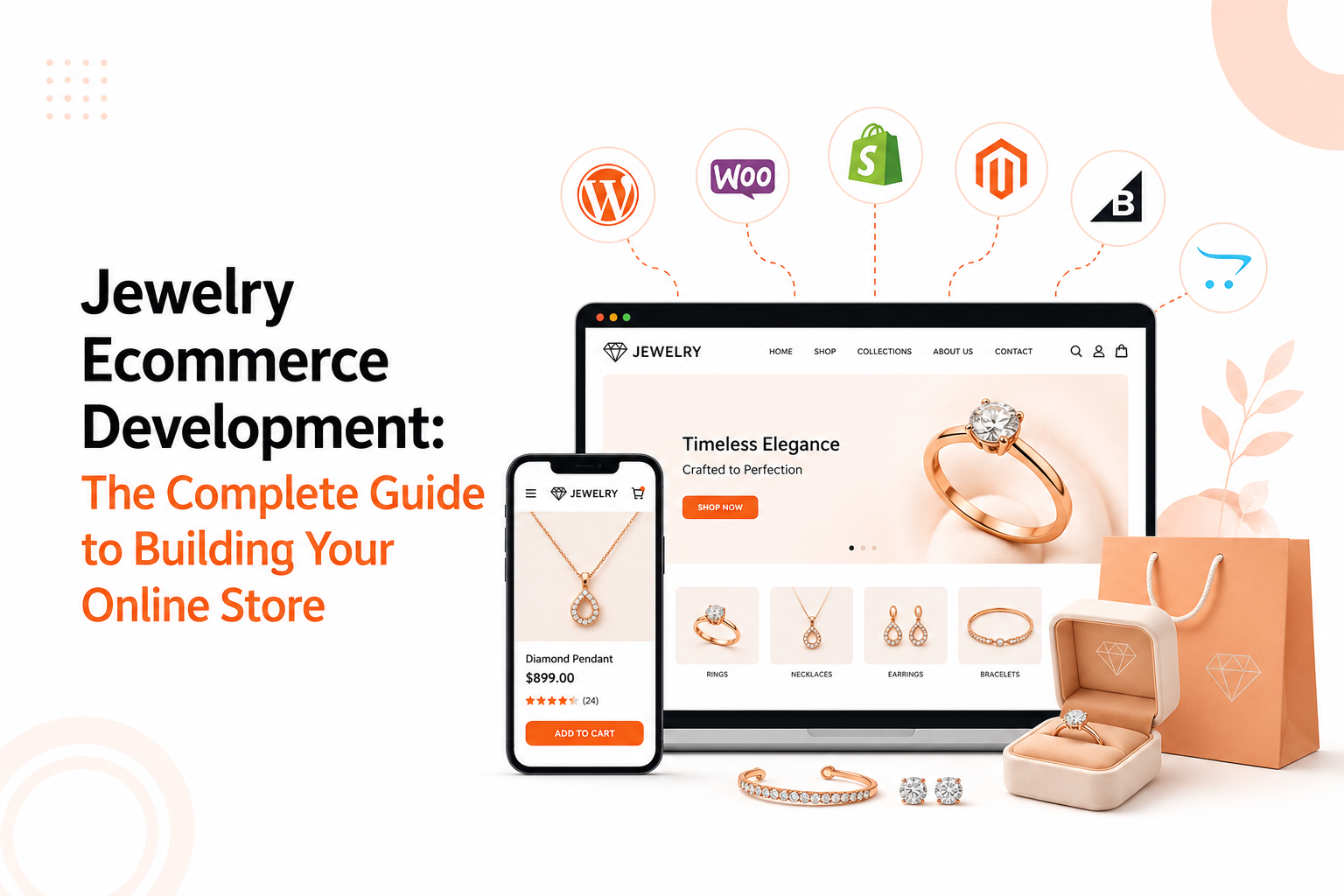
Jewelry Ecommerce Development: The Complete Guide to Building Your Online Store
Somebody is about to spend $1,800 on an engagement ring they’ve never touched.
They can’t feel the weight of the band, hold it up to the light, or ask a salesperson to explain why one diamond costs double another that looks identical to the naked eye. All they have is your website, a few photographs, and about four minutes of attention before they either trust you enough to check out – or open a new tab and buy from Blue Nile instead.
That’s the entire challenge of jewelry ecommerce development in one sentence. It isn’t really a website project. It’s the job of replacing a jeweller standing behind a glass counter, using nothing but pixels. Most general ecommerce guides don’t talk about this, because most products don’t carry this much doubt at checkout. A phone case or a t-shirt doesn’t need a certificate of authenticity. A $3,000 diamond pendant does.
If you’re a jeweller, designer, or retailer trying to figure out how to actually build this – not just “get a website,” but build something that makes a stranger comfortable paying real money for a small box they can’t inspect – this guide walks through it properly: what the site needs, what it costs, which platform fits, and where jewelry sellers most often lose sales without realising why.Why Jewelry Ecommerce Is a Different Category Entirely?
Why Jewelry Ecommerce Is a Different Category Entirely?
Most ecommerce advice assumes a fairly simple product: pick a size, add to cart, done. Jewelry breaks that model in almost every direction.
The average order value is high. A typical jewelry purchase runs anywhere from a few hundred to several thousand dollars, which means every visitor is making a bigger decision than they would for most online purchases – and bigger decisions demand more reassurance, not less.
The product has near-infinite variants. A single-ring design might be available in yellow gold, white gold, rose gold, and platinum across 10 ring sizes, with three stone options and an optional engraving field. That’s not one product – it’s potentially 100+ SKUs hiding behind one product page, and your site needs to handle that without confusing the buyer.
Trust has to be engineered in, not assumed. Buyers can’t verify a diamond’s clarity or a chain’s karat weight by looking at a photo. Every serious jewelry ecommerce site leans hard on certification (GIA, IGI, AGS reports), return policies, and visible security – because the sale genuinely does not happen without it.
The visual bar is higher. Jewelry sells on sparkle, detail, and scale – things that are genuinely hard to capture in a flat product photo. Buyers consistently want to see pieces styled on a hand or neck, not just floating on white, and a large share say they’d use a virtual try-on feature if one were available.
None of this means jewelry ecommerce is harder to succeed at – it just means the standard “launch a store, list some products” checklist isn’t enough. The rest of this guide covers what actually needs to be different.
The Opportunity (and the Risk) of Selling Jewelry Online
This isn’t a shrinking market you’re trying to squeeze into – it’s a category still shifting online. The global jewelry market was valued in the region of $340 billion in 2026, and industry forecasts put the online jewelry segment growing at roughly 20%+ a year through the rest of the decade, faster than jewelry retail as a whole.
Engagement rings and bridal jewelry in particular are seeing some of the highest average order values of any online product category. Buyers who once considered jewelry too personal or too expensive to buy sight-unseen have, over the last decade, proven they will – provided the website does the reassurance work a salesperson used to do.
That last part is the whole opportunity, and the whole risk. Get the trust and presentation right, and jewelry converts extremely well online. Get it wrong, and visitors bounce silently – no complaint, no abandoned cart email trigger, just a closed tab.
What a Jewelry Ecommerce Website Actually Needs?
This is the checklist most generic “how to build an online store” articles skip, because it’s specific to selling something people can’t touch before they buy it.
Visual presentation
- High-resolution zoom on every product image – buyers want to inspect facets, prong settings, and engraving detail closely, not squint at a thumbnail.
- 360-degree product views, ideally video, so a ring or bracelet can be seen from every angle rather than one flattering front shot.
- Styled/lifestyle photography – pieces shown on a hand, wrist, or neck, not just isolated on white. This is one of the biggest gaps between amateur and professional jewelry stores.
- AR or virtual try-on, where budget allows. A large share of jewelry shoppers say they’d use this if it were available, and it directly reduces the “what if it doesn’t suit me” hesitation that kills conversions.
Product configuration
- Clean variant selection for metal type, stone, ring size, chain length, and engraving – without forcing the buyer to dig through separate listings for each combination.
- A sizing guide built into the product page (ring sizers, chain length visualisations), since sizing uncertainty is one of the most common reasons jewelry carts get abandoned.
- A “design your own” or build-your-own configurator for engagement rings and custom pieces, if that’s part of your offer – this has become close to an expectation in the bridal category rather than a nice-to-have.
Trust and credibility
- Certification display – GIA, IGI, or AGS grading reports linked directly to the relevant product, not buried in a policy page.
- Transparent return, warranty, and insurance policies, stated clearly on the product page itself, not just in a footer link.
- Visible security signals – SSL, PCI-DSS compliant payment processing, and recognisable payment badges – matter more here than almost any other product category, because the transaction values are higher.
- Real reviews and social proof, ideally with photos, since buyers weigh other customers’ experience heavily for a purchase this personal.
Operational features
- Real-time metal price syncing, if you sell by weight or in fluctuating precious metals – static pricing on a gold-based product is a fast way to either lose margin or lose trust when prices move.
- Secure checkout and fraud protection tuned for higher-value transactions, since jewelry orders are a common target for payment fraud.
- Inventory accuracy across channels, especially if you also sell on Etsy, Amazon, or in a physical store – nothing damages trust faster than confirming an order for a one-of-a-kind piece that already sold elsewhere.
If your current site is missing more than two or three of these, that’s usually not a design problem – it’s a trust gap, and it shows up as a quiet, unexplained drop-off rather than an obvious complaint.
Choosing the Right Platform for a Jewelry Store
Platform choice matters more for jewelry than for most product categories, because the platform decides how well you can handle variants, certification data, and high-resolution visuals without the site slowing down.
Shopify is the most common choice for jewelry brands today, mostly because of its app ecosystem – apps exist specifically for ring builders, gold-price syncing, certificate display, and AR try-on, which means you’re rarely building these from scratch. It’s a strong starting point for most independent jewelers and small-to-mid brands.
BigCommerce is worth a look if you’re planning heavier customisation (a full build-your-own-ring configurator, for example) or expect to sell wholesale/B2B alongside retail, since more of that capability is built into the core plan rather than needing a stack of apps.
WooCommerce suits jewelers who already have a WordPress site built around brand storytelling and content – blog posts about the “4 Cs,” gemstone education, styling guides – and want the store integrated into that rather than living on a separate platform.
Magento (Adobe Commerce) becomes relevant once you’re managing a large catalogue with complex configuration logic – think a diamond retailer syncing live inventory from a global stone feed – where off-the-shelf apps genuinely can’t do what you need.
We’ve written a full breakdown of how these platforms compare on cost, features, and scalability in our ecommerce platform comparison guide – worth reading alongside this one if you haven’t settled on a platform yet.
Jewelry Ecommerce Development Cost: A Realistic Breakdown
Jewelry sites cost more than an average ecommerce store to build properly, mainly because of the photography, variant complexity, and trust features covered above. Here’s a realistic range based on how most jewelry stores actually get built in 2026.
| Approach | Typical cost | What you get |
| DIY on Wix or a template builder | $500–$3,000 | Fast to launch, works for a small catalogue, limited variant and certification handling |
| Shopify with a paid theme + light customisation | $3,000–$8,000 | Solid starting point for most independent jewelers; apps cover most jewelry-specific needs |
| Shopify or BigCommerce with an agency build | $15,000–$60,000 | Custom theme, ring builder, gold-price sync, AR integration, professional photography |
| WooCommerce with a developer | $5,000–$25,000 | Full control, integrated with existing WordPress content, needs more technical upkeep |
| Enterprise / Magento build | $50,000–$200,000+ | Large catalogues, live diamond feeds, multi-channel inventory, full custom logic |
Note
These are approximate industry ranges for 2026 and can vary based on catalog size, required features (ring configurator, AR try-on, live metal pricing, ERP integration, etc.), agency location, and project complexity. Actual costs may be higher or lower. Always get a detailed quote based on your specific requirements. Photography, ongoing apps/maintenance, and marketing costs are not fully included in the above figures.
A few cost factors are specific to jewelry and catch first-time builders off guard: professional jewelry photography and 360-degree rendering alone can run $5,000–$15,000+ for a full catalogue, and building in AR or advanced sizing tools typically adds $2,000–$8,000 on top of a standard ecommerce build. It’s genuinely one of the categories where cutting the photography budget to save money costs more in lost trust than it saves in dollars.
This is exactly the kind of budgeting conversation we have upfront with jewelry clients at Ganatra Info – matching the build to your actual catalogue size and price point, rather than quoting a number before understanding whether you’re selling $80 studs or $8,000 engagement rings.
Common Mistakes Jewelry Stores Make (and What They Cost)
A few mistakes come up again and again in jewelry ecommerce specifically, beyond the general ecommerce mistakes covered in our guide to the mistakes that quietly kill new online stores:
- Photographing jewelry like a generic product. A ring shot flat on white with no scale reference or styling leaves the buyer guessing how it actually looks worn – and guessing kills high-value purchases.
- Hiding certification instead of featuring it. Burying a GIA report as a PDF download instead of displaying it directly on the product page removes the exact reassurance the buyer needed at the moment of doubt.
- Underestimating sizing friction. No sizing guide, or a generic one that doesn’t match your actual product line, is one of the most common silent causes of cart abandonment in this category.
- Static pricing on precious metals. Selling by weight without syncing to current gold or silver prices either erodes margin on every sale or forces awkward manual price corrections.
- Treating security as a backend detail. For a $2,000+ purchase, visible trust signals – SSL, recognisable payment logos, clear return policy – aren’t decoration. Their absence is often the actual reason a cart gets abandoned.
Building the Right Foundation
A jewelry ecommerce site earns trust the same way a good in-store salesperson does – by showing the product properly, answering the unspoken doubts before they’re asked, and making the buyer feel like the risk is on the seller’s side, not theirs. Get that right, and the platform, the design, and the marketing all work harder for you.
If you’re at the stage of actually scoping a build – whether that’s a first Shopify store for a small jewelry brand or a custom platform for a growing catalogue – a short conversation is usually more useful than another article. The team at ganatrainfo.com offers a free consultation to map out what your specific catalogue and price point actually need, with a straight platform and cost recommendation either way.
FAQ
How much does jewelry ecommerce website development cost?
Jewelry ecommerce sites typically cost more than a standard online store because of photography, variant handling, and certification display. A realistic range runs from $3,000–$8,000 for a well-executed Shopify build for an independent jeweler, up to $15,000–$60,000 for a fully custom agency build with a ring configurator, AR try-on, and live pricing. Enterprise builds with live diamond feeds and multi-channel inventory can run $50,000–$200,000+.
What is the best ecommerce platform for a jewelry business?
Shopify is the most common choice for independent and small-to-mid jewelry brands because of its app ecosystem for ring builders, gold-price syncing, and certificate display. BigCommerce fits better if you need heavier built-in customisation or B2B/wholesale alongside retail. WooCommerce works well if your brand already runs on WordPress content. Magento (Adobe Commerce) becomes the right call for large catalogues with complex live-inventory needs. There’s a full comparison in our ecommerce platform guide.
Do I really need AR or virtual try-on for a jewelry website?
It’s not mandatory, but it’s increasingly expected in categories like engagement rings, where a large share of shoppers specifically say they’d use a try-on feature if offered. If budget is tight, prioritise it after the fundamentals – high-resolution zoom, 360° views, styled photography, and clear sizing – since those affect every visitor, while AR mainly helps buyers who are already close to deciding.
How is a jewelry ecommerce site different from a regular online store?
The main differences are trust and configuration complexity. Jewelry purchases carry higher average order values and can’t be physically inspected, so certification, security signals, and return policy transparency matter far more than in most product categories. Products also tend to have many more variants – metal, stone, size, engraving – that need to be handled cleanly on a single product page rather than as separate listings.